'Star Wars' Guidebook: Jedha
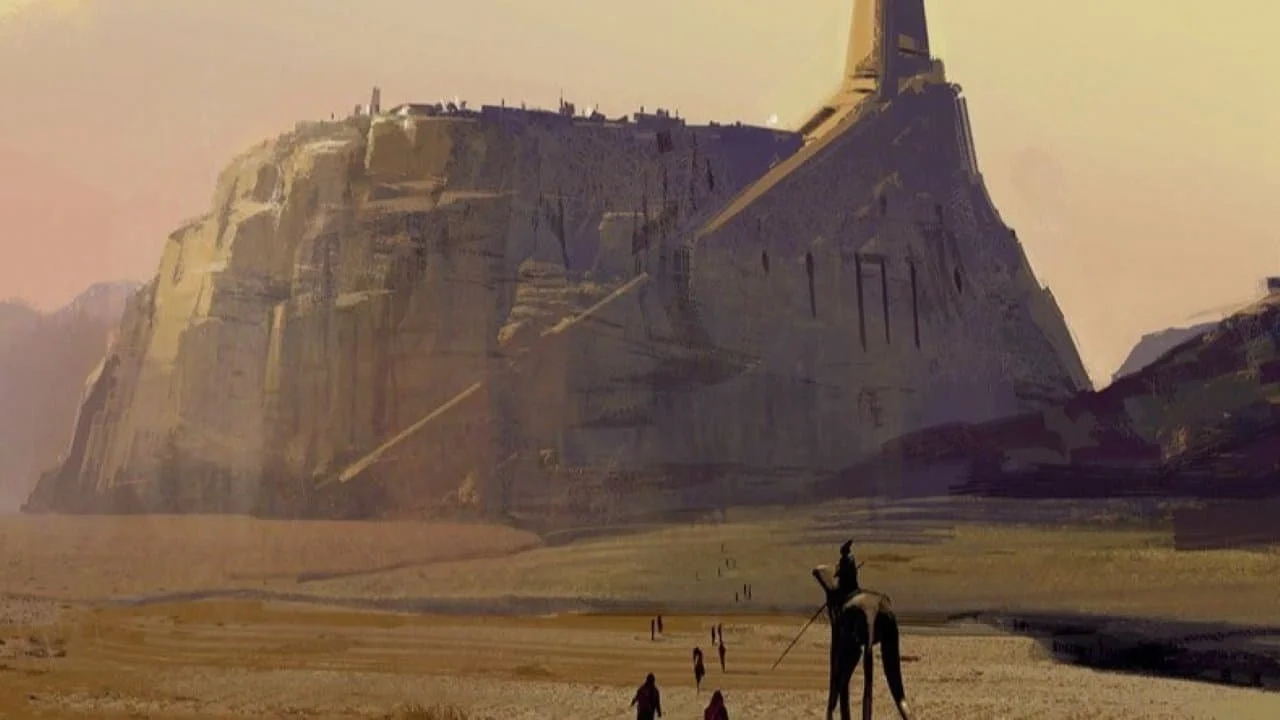
Image Source: StarWars.com
The Star Wars galaxy consists of billions of stars and millions of inhabited worlds. Some of them are birthplaces of certain characters, locations of temporary refuge, or sites of exchange of certain goods and services, but some of these worlds hold a greater importance for the overall story of Star Wars. One of these worlds is Jedha.
WARNING: This article contains MAJOR SPOILERS for Star Wars: Jedi: Survivor.
General Information
Location
Jedha was a moon orbiting the crystal-covered planet NaJedha, located in the Jedha system in the Terrabe sector. The system was located in the Mid Rim, but at such a western point that it skirted the Unknown Regions.
To the surprise of many, Jedha was not a humid world; its desert landscape was cold and biting, rather than sweat-inducing. Aside from its broad tracks of deep sand, Jedha was also incredibly rocky, its landscape dotted by great mesas and mountains. Much of this rocky terrain was a deep brown color that complemented the orange-tinged sand that surrounded it. There were sources of water across the world, though these were limited and not easily seen on the surface. The Narkis Highlands were a notable geological feature of the world, located far from Jedha City, the moon’s only major settlement.
RELATED:
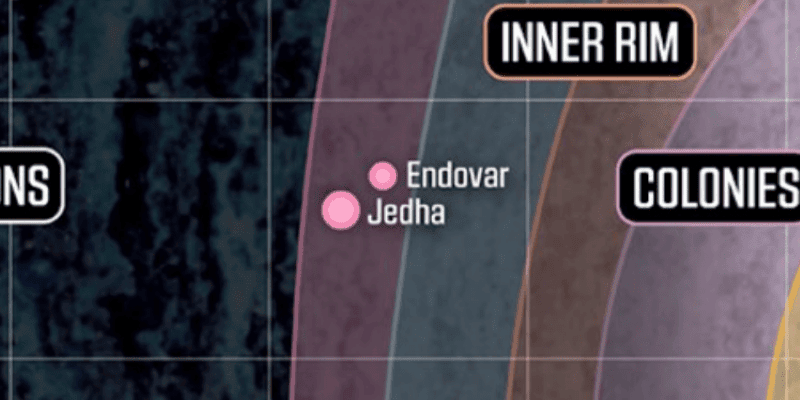
Image Source: StarWars.com
Landscape
Population And Society
Jedha was unique as a world settled for thousands of years before even the High Republic era, and was one of the worlds debated as the origin point of the Jedi Order among scholarly circles. What is certain, however, is the ancient nature of the world’s settlement by external parties, with many ruins dotting the world with a link to the Jedi. Other groups also made their home on Jedha over the millennia, though most of them ultimately focused their attention on Jedha City in the years approaching and including the Skywalker Saga.
Major Settlements And Landmarks
Jedha City
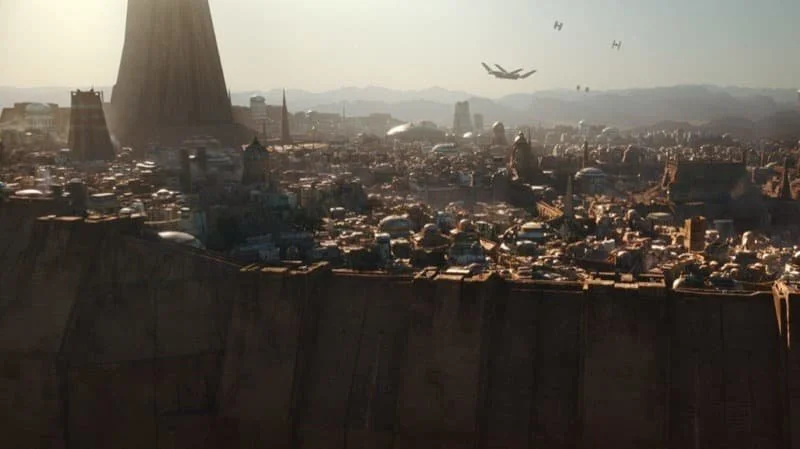
Image Source: StarWars.com
Also called NiJedha, or the Holy City, Jedha City was a walled settlement sitting atop a mesa. It overflowed with housing for the local populace, but Jedha earned its name as the Pilgrim Moon for a reason, with the adherents of many faiths also visiting the world for spiritual and religious reasons. The City was divided into two areas (called old and new, yet each millennia old), and the grandest structure in the City was the Temple of the Kyber, which stood tall above the landscape. Other notable sites in the city included the Dome of Deliverance and the Second Spire. Heavily damaged during the Battle of Jedha, the settlement quickly rebuilt, though it gradually lost its prominence to the Jedi, who had retreated from the world by the time of the Clone Wars. It was ultimately annihilated by the Empire, bringing likely over 20,000 years of history to an end.
The Archive And The Pilgrim’s Sanctuary
Found in the Narkis Highlands, the Archive and the Pilgrim’s Sanctuary were locations important to the Path and the Narkis Anchorites, an order of religious knowledge seekers. Allies to Cere Junda as the Path sought to aid the escape of Force sensitives from the Empire, the Anchorites also helped her organize the vast collection of the Archive, which contained knowledge on the Jedi as well as many other subjects. The Pilgrim’s Sanctuary, meanwhile, was a large abandoned temple used as a safehouse by the Path, and was of uncertain theological link (be it to the Jedi, Anchorites, or others unknown). The Archive was ultimately destroyed by Darth Vader, while Pilgrim’s Sanctuary was similarly raided, both sites lost to the Empire.
Notable Fauna
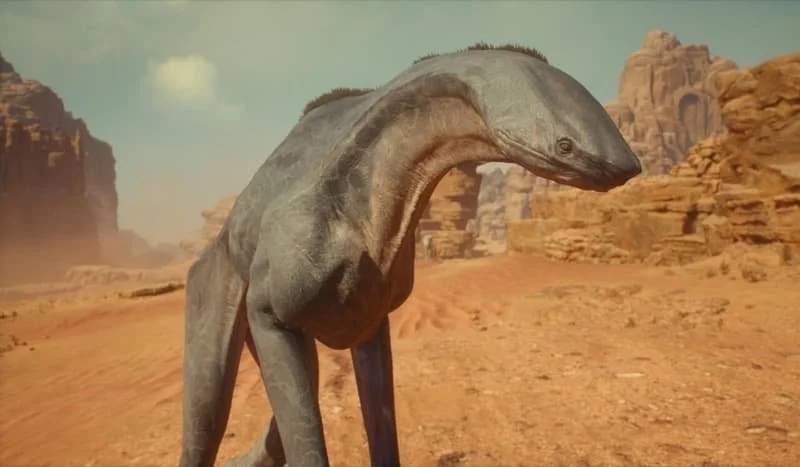
Image Source: Wookieepedia
Despite its harsh environment, Jedha supported an array of unique lifeforms. On the gentler side were the Spamel, long-legged quadrupedal creatures which could be ridden and were used by locals and visitors for travel across the hostile terrain. They could gallop with speed and grace, and would survive the near-annihilation of the moon. On the larger, more aggressive side were creatures like the Sutaban and the Skriton. Sutaban were known for their great speed and force of attack, while Skritons were ambush predators that remained hidden under the sand before erupting upward. They also had lopsided body plans that favored one huge snapping claw over the other, though made up for this potential imbalance with a large mouth and a long stabbing tail.
History
As mentioned earlier in this article, Jedha has a long, mysterious history, closely linked to many faiths that held the Force (or powers in the galaxy that did not use that term) as sacred. Dense with kyber crystals, the world attracted settlement by these faiths, orders, and churches across the millennia, with Jedha as one of the worlds argued as the founding world of the Jedi Order alongside the likes of Ossus and Tython because of this ancient association. Over those millennia, great statues of Jedi were carved and stood tall over the landscape, and some would remain into the era of the Galactic Republic, after the fall of the Old Republic.
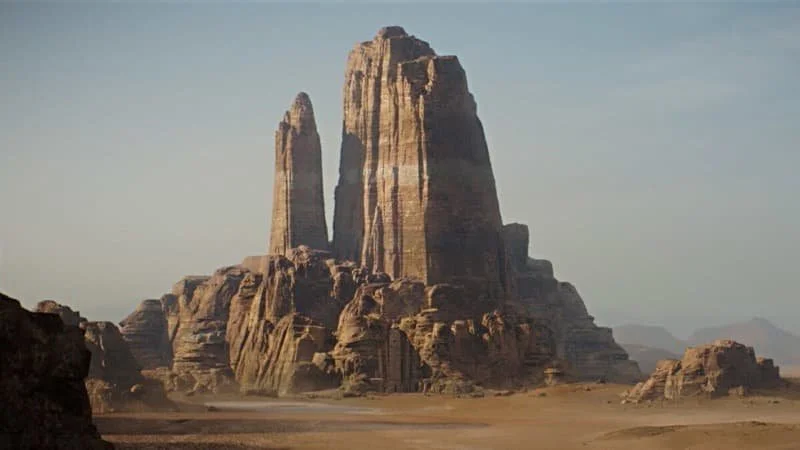
Image Source: StarWars.com
During the High Republic, a peak of power and prosperity for the Galactic Republic, Jedha became a world of significance. Attempting to affirm unity and cooperation in line with the Republic’s values, the Jedi helped to found the Convocation of the Force, a group made up of representatives serving as liaisons for a range of notable faiths dominant in the city at the time. However, the manipulations of Elecia Zeveron would lead to the Battle of Jedha, a destructive, chaotic event that greatly damaged the moon’s Holy City. While it was rebuilt and recovered, the Jedi ultimately withdrew from the moon, leading other groups to rise to prominence.
With the eventual rise of the Empire, Jedha’s ancient links to the Jedi made it a prime target for oppression, especially as the Empire required vast quantities of kyber crystals, found naturally within deep caverns and found refined in the holy places of the moon, but especially in the Temple of the Kyber. The Empire began excavations of the moon, using all manner of technology, and also expanded its operations beyond the Holy City. Under their noses, Cere Junda, the Nightsister Merrin, and others helped to run a Path safehouse, an underground smuggling ring seeking to save Force-sensitives from the Empire, alongside collecting and preserving Jedi knowledge. The Empire, unfortunately, discovered the Path after events elsewhere in the galaxy, and led by Darth Vader, killed Cere Junda and destroyed the vast databanks of knowledge they had been preserving. But the Path itself lived on, even if they left Jedha behind.
Ultimately, the Empire refocused its efforts on Jedha City, and this is when Saw Gerrera arrived. Unaware of the exact nature of the Death Star, but knowing the Empire was building a vast project that needed kyber crystals, Saw and his Partisans began attacking Imperial convoys and patrols, harassing the occupiers but also doing significant collateral damage to the City. Having already broken away from the core Rebel Alliance, Saw’s actions on Jedha made him a pariah with his fellow Rebels and led to an awkward situation when the newly-freed Rebel-allied Jyn Erso had to reach him to talk about what he had learned about the Death Star.
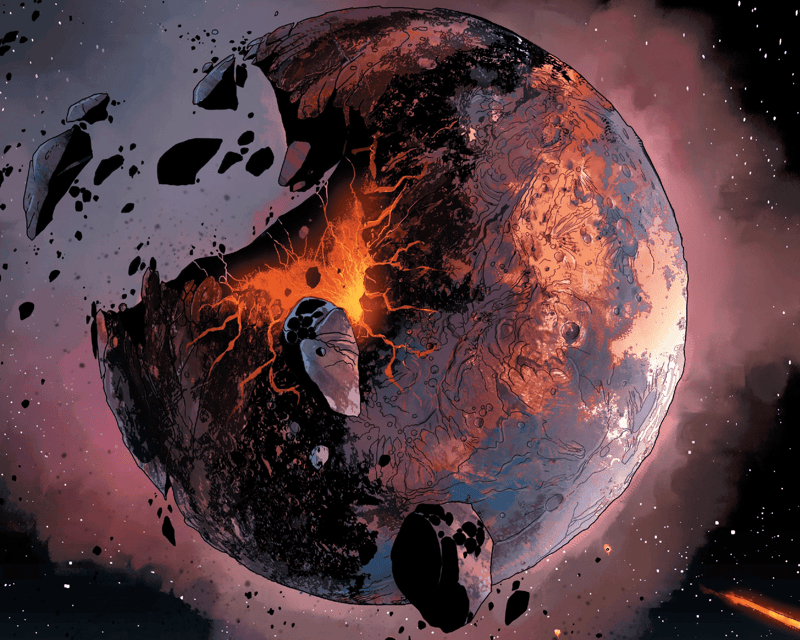
Image Source: Wookieepedia
The Empire, realizing that the secret of the Death Star was beginning to leak as a result of Saw’s capture of the Imperial pilot Bodhi Rook, used Jedha as the test site for a weak blast of their ultimate weapon. Targeting Jedha City itself, millions died in the colossal explosion as the world was torn apart. Months later, Jedha was an utter ruin of a moon, barely habitable and highly unstable, but still holding survivors of the civilian populace and the Partisans. The Empire, once again in need of kyber after the destruction of the First Death Star, began to mine the ruins of Jedha, only to meet fierce resistance in the form of the Partisans, who had since been bolstered by many of the survivors joining them. Struggling to accomplish their task, the Empire sent Queen Trios of Shu-Toran to handle the situation, though they were unaware of the elaborate game she would play to win the trust of the Rebels at the command of Darth Vader. Imperial mining of Jedha likely ceased after the failure of Queen Trios, and the ultimate fate of Jedha’s remnants is a mystery.
Appearances Of Jedha In The Canon
First appearing in Rogue One, Jedha has since been greatly expanded by its inclusion in several media and across eras, appearing in comics, books, and video games as well as both the Skywalker Saga and playing a notable role in Phase Two of The High Republic. Jedha continues to remain prominent in the lore of the universe as a result and will likely appear in near-future books and comics. One likely place for its inclusion is in The High Republic: Pathfinder, the upcoming post-Phase 2 comic series from Dark Horse, being written by George Mann who worked alongside Cavan Scott in developing the Battle of Jedha in The High Republic.
CultureSlate: Made by humans, for humans
READ NEXT:


Source(s): The Battle of Jedha, The High Republic (2022), The High Republic Adventures (2022) Volume 1 + Volume 2, Tales of Enlightenment, Cataclysm, Path of Vengeance, Star Wars: Jedi: Survivor, The Art of Star Wars: Jedi: Survivor, Rogue One, Star Wars (2015) Volume 7 - Ashes of Jedha, Star Wars Encyclopedia: The Comprehensive Guide to the Star Wars Galaxy, Wookieepedia
Latest News

Featured